Reading TAF
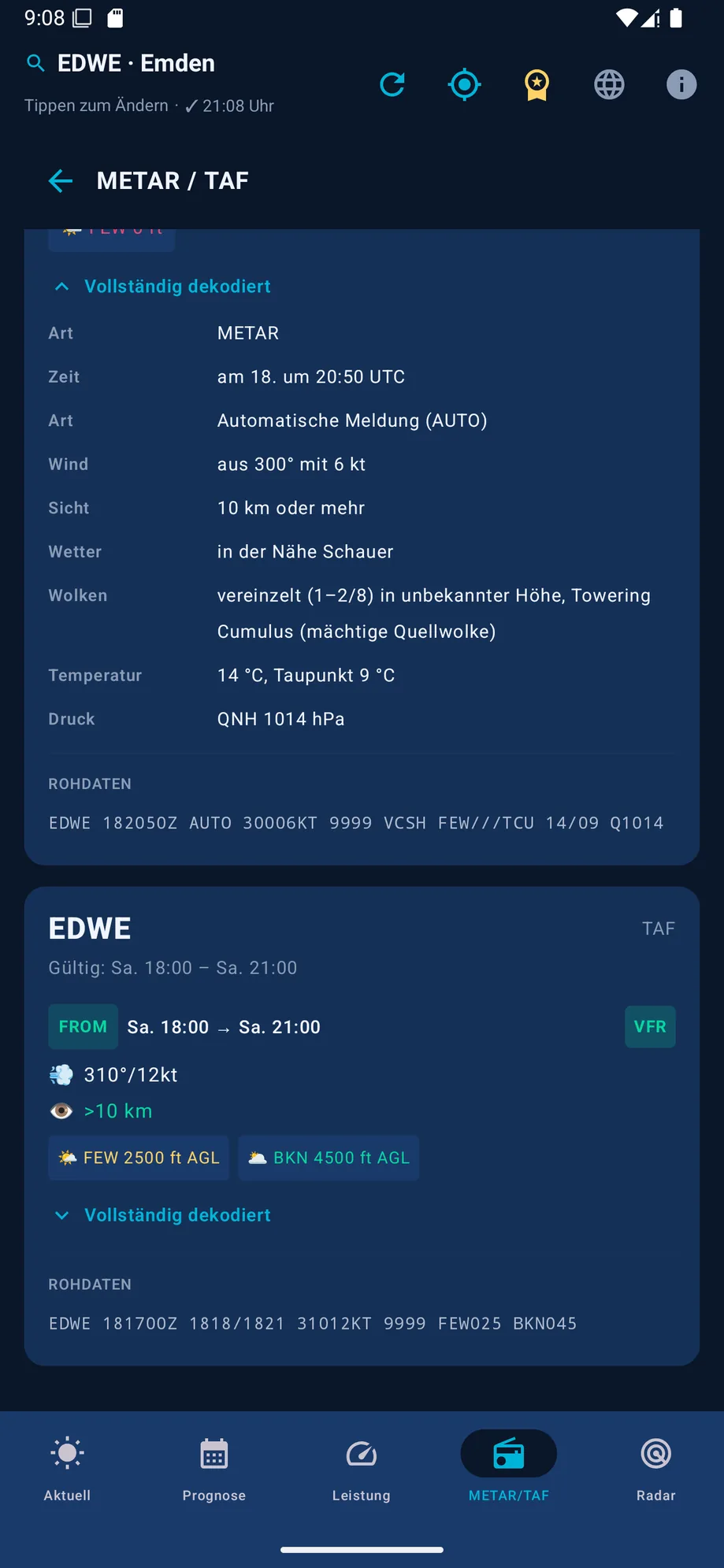
The TAF (Terminal Aerodrome Forecast) is an airport's weather forecast, usually covering 24 or 30 hours ahead and updated every 6 hours – smaller airfields often only get a short TAF covering 9 hours, updated every 3 hours. Unlike the METAR, it doesn't just describe the current state – it also shows how and when the weather will change. If you already know the basic groups from a METAR, you're halfway there – what's new is mainly the change groups. For individual abbreviations, see the full METAR/TAF glossary.
A sample TAF
A forecast for Frankfurt might look like this:
TAF EDDF 151105Z 1512/1618 24012KT 9999 SCT035 BECMG 1514/1516 26018G28KT TEMPO 1516/1520 4000 SHRA BKN018CB FM152000 28010KT CAVOK PROB30 TEMPO 1606/1610 3000 BR
Five lines, but each describes a different time slice of the forecast. Taking them in order:
Header and validity
TAF EDDF: report type and ICAO code, just like a METAR. 151105Z: issued on the 15th at 11:05 UTC. 1512/1618 is the validity period in DayHour/DayHour format: from day 15, 12:00 UTC to day 16, 18:00 UTC. Outside this window the TAF doesn't apply – for the time before or after, you need the previous or next forecast.
Base conditions
24012KT 9999 SCT035: wind, visibility and cloud are given exactly as in a METAR – here 240° at 12 kt, visibility 10 km or more, a few clouds at 3,500 ft. These base conditions apply at the start of the validity period and remain in effect until a change group forecasts something different.
BECMG – gradual change
BECMG 1514/1516 26018G28KT: "Becoming" announces a gradual transition. Between 14:00 and 16:00 UTC on the 15th, the wind backs to 260° and picks up to 18 kt with gusts to 28 kt. Exactly when within that window the change happens is left open – plan conservatively with the less favorable value.
TEMPO – temporary fluctuation
TEMPO 1516/1520 4000 SHRA BKN018CB: "Temporary" flags brief dips that can come and go repeatedly without holding the whole time. So between 16:00 and 20:00 UTC on the 15th, showers with visibility down to 4,000 m and a towering cumulonimbus at 1,800 ft may occur at times – not continuously, but possible at any point. The exact rules (maximum duration per occurrence, maximum total share) are in the glossary.
FM – a clean break
FM152000 28010KT CAVOK: "From" marks a sharp cutover. From exactly 20:00 UTC on the 15th, completely new conditions apply – here wind 280° at 10 kt and CAVOK. Unlike BECMG, there's no transition: the previous forecast line ends and a new one begins.
PROB30 – probability
PROB30 TEMPO 1606/1610 3000 BR: "Probability 30" means there's a 30% chance of mist with visibility down to 3,000 m occurring temporarily between 06:00 and 10:00 UTC on the 16th. PROB30 and PROB40 are often combined with TEMPO and show how confident the forecast is about a given condition – important for your own risk assessment, especially in marginal weather.
Frequently asked TAF questions
What's the difference between BECMG and TEMPO?
BECMG describes a lasting transition to new conditions – the new state remains afterward. TEMPO describes brief, temporary fluctuations that come and go repeatedly while the base conditions otherwise persist.
What does PROB30 mean in a TAF?
PROB30 states a 30% probability of the following condition occurring – usually combined with TEMPO. PROB40 is the 40% equivalent. Both appear exclusively in TAFs, never in a METAR.
How long is a TAF valid?
Depending on airport size, 9, 24, or 30 hours, shown by the validity period in the report's header (DayHour/DayHour format). Outside that window, a newer or older forecast applies instead.
What's next?
The best way to read a TAF is line by line, as a timeline: base conditions, then each change group in order. For the meaning of individual abbreviations like weather codes or cloud levels, the full glossary helps. For daily preparation, the METAR/TAF decoder in VFR Wetter handles this breakdown automatically and factors TAF risk for the next 6 hours directly into the central flight weather assessment.
This article does not replace aviation training or an official flight weather briefing. Before every flight, the actual official reports and regulations apply.