Calculating Crosswind
The crosswind component is the part of the wind blowing across the runway rather than along it. It helps decide whether a runway is suitable for takeoff or landing – and it's quick to estimate with a bit of trigonometry or a simple rule of thumb.
The formula
First work out the angle between wind direction and runway heading (both in degrees; runway 27 corresponds to 270°). Then:
Crosswind = wind speed × sin(angle) Headwind/tailwind = wind speed × cos(angle)
If the angle is under 90°, you have a headwind; over 90°, a tailwind – with correspondingly shorter or longer takeoff and landing distances.
The rule-of-thumb table
Without a calculator, this rounded approximation – often called the "clock code" in radio jargon – usually gets you close enough:
- 10° off: ≈ 20% of wind speed as crosswind
- 20° off: ≈ 35%
- 30° off: ≈ 50% (half)
- 45° off: ≈ 70%
- 60° off: ≈ 87%
- 90° off: 100% – the entire wind is across the runway
A worked example
Runway 27 (270°), wind from 240° at 20 kt, gusting to 30 kt:
- Angle: 270° − 240° = 30°
- Crosswind (mean): 20 kt × sin(30°) = 20 × 0.5 = 10 kt
- Crosswind (gust): 30 kt × sin(30°) = 30 × 0.5 = 15 kt
- Headwind (mean): 20 kt × cos(30°) ≈ 20 × 0.87 ≈ 17 kt
The 30° rule of thumb ("half") gets you to the same answer as the exact formula, without a calculator.
How much crosswind is too much?
There's no universal number. Many flight manuals (POH) state a demonstrated crosswind velocity – the crosswind component actually flown during type certification, not necessarily the maximum possible one. It's usually not a hard operating limit, but an important reference point: experience, currency and the gust factor matter at least as much as the raw number in the manual for your own personal limit. When in doubt: pick the runway with the least crosswind, or divert.
Frequently asked crosswind questions
What is "demonstrated crosswind velocity"?
The crosswind component actually flown by the manufacturer during certification, not necessarily the maximum possible one. It's stated in the POH and isn't a hard operating limit, but an important reference point for your own risk assessment.
How do I calculate the angle between wind and runway?
Wind direction minus runway heading (both in degrees; the runway heading is the runway number times 10, e.g. runway 27 = 270°). Reduce the result to the 0°–90° range, then look it up in the rule-of-thumb table.
What about gusts?
Use the same formula for the gust component, but with the peak gust speed instead of the mean wind speed – it shows the worst-case scenario at the moment of touchdown.
What's next?
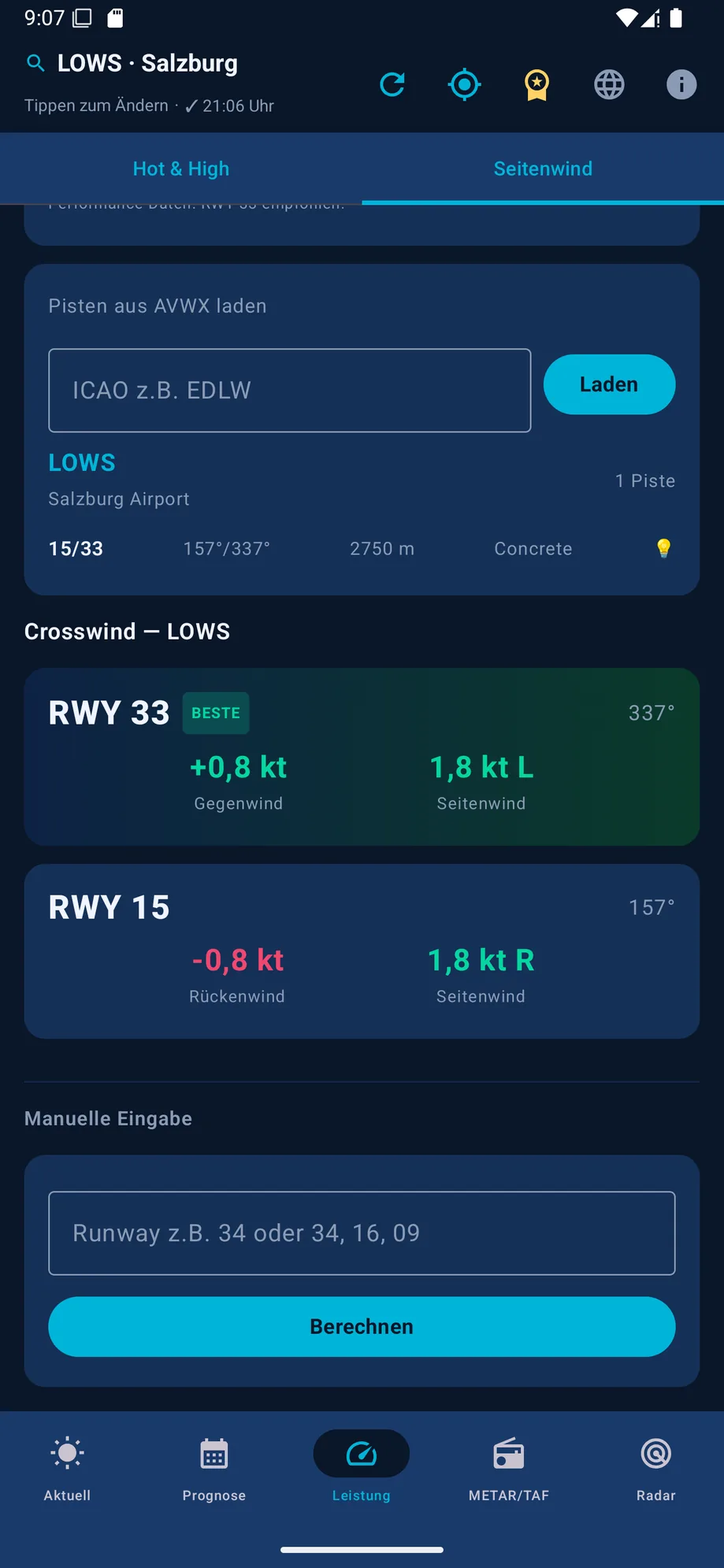
For everyday use, you don't need to keep sines or the rule-of-thumb table in your head: the crosswind calculator in VFR Wetter automatically loads runway data for the selected airport and shows the crosswind and headwind component per runway heading – including a recommendation for the most favorable one. Air density affects takeoff performance too – see Calculating Density Altitude.
This article does not replace POH figures or aviation training. Your actual crosswind limit for your aircraft type and your personal experience is set exclusively by you and the flight manual.